La Belle Americaine: The Hidden Architect of American Diplomacy
A note from the author (me 😂): I never expected to write this story.
A few weeks ago, as part of my dear friend birthday party tour, we visited James Monroe's Highland estate in Virginia, one of those tours where you expect to learn something in 15 minutes (about a president), nod politely at the furniture, and leave with a vague sense of having done something educational. Instead, I left completely struck by someone else entirely: his wife.
Elizabeth Monroe. The guide mentioned her almost in passing, a few sentences about how she saved Lafayette's wife from the guillotine, something about her being "reserved" as First Lady and few more things. But those few sentences lodged in my brain like a splinter. A reserved woman who rode through revolutionary Paris to save a condemned prisoner? That contradiction felt like a story waiting to be told.
So I did what I always do when something catches my attention: I started digging. I am a writer, after all, and writers cannot not write stories. It is a compulsion, really, this need to chase down a character and figure out what made them tick.
What I found surprised me. The more I researched, the more I realized that Elizabeth Monroe was not the fragile, retiring figure that history books describe. She was strategic. She was brave. She understood power in ways that most people, then and now, completely miss.
Everything you are about to read is based on historical facts. The events happened. The documents exist. But the conclusions about her character, her unique wisdom seen through her decisions, her quiet bravery - those are mine. Because facts alone do not make a story. What makes a story is understanding why someone did what they did.
I think Elizabeth Monroe would appreciate that her story is finally being told. I also think she might be slightly annoyed that someone is poking around in her private life, since she went to considerable trouble to burn most of the evidence.
But that is the thing about being remarkable: eventually, someone notices.
1768 - 1830
History remembers the men who shaped nations, but often forgets the women who stood beside them, behind them, and sometimes far ahead of them. Elizabeth Kortright Monroe was one such woman. She never held office, never signed a treaty, never commanded an army. Yet she saved a life that would echo through French and American history, raised a daughter who would befriend future queens, reshaped the very definition of what a First Lady could be, and then methodically ensured that her private counsel would remain exactly that: private.
This is the story of a woman who understood power not as something to seize, but as something to wield with precision, grace, and extraordinary courage.
Part One: The New York Belle (1768-1786)
A merchant's daughter in a world at war
Elizabeth Kortright was born on June 30, 1768, into a world of contradictions. Her father, Lawrence Kortright, had made his fortune as a privateer during the French and Indian War, serving the British Crown with ruthless efficiency. Her mother, Hannah Aspinwall, came from old New York money, with family connections that would later link the Kortrights to the Roosevelts themselves.
The Kortrights lived well in Manhattan, wealthy merchants in a city that would soon become the crucible of revolution. But when the American colonies declared independence in 1776, Lawrence Kortright made a fateful choice: he took no active part in the War of Independence. Neither patriot nor loyalist, he watched from the sidelines as his fortune slowly bled away, "injured," as James Monroe would later write to Thomas Jefferson, "by the Revolution."
Eight-year-old Elizabeth grew up in the shadow of this calculated neutrality. She learned early that survival sometimes meant knowing when not to act, a lesson that would serve her well in the dangerous courts of revolutionary France. She also learned something else: that a woman's power often lay not in direct action but in strategic positioning, in being present at the right moment, in the carefully chosen gesture.
A revolutionary romance
In 1786, Elizabeth was seventeen years old and, by all accounts, stunningly beautiful. James Monroe was twenty-seven, a Lieutenant Colonel who had crossed the Delaware with Washington, taken a bullet at Trenton, and was now serving as a Virginia congressman. He had political ambitions, powerful friends including Thomas Jefferson, and almost no money.
It was, on paper, a strange match. A patriot veteran marrying the daughter of a man who had sat out the revolution? But James Monroe was not thinking about politics when he met Elizabeth Kortright. He was thinking about the dark-haired, elegant young woman who carried herself with a composure far beyond her years.
They married on February 16, 1786, at Trinity Episcopal Church in New York. The bride was not yet eighteen. After a brief honeymoon on Long Island, they moved in with her father, and then, when Congress adjourned, to Virginia, where Monroe would practice law. Their daughter Eliza was born that December.
What no one could have predicted was that this young wife, raised in comfortable Manhattan neutrality, would soon find herself in the most dangerous city in the world, making a decision that would save a woman's life and change the course of Franco-American relations.
Part Two: The Carriage Ride That Changed History (1794-1795)
Paris in the Terror
In 1794, President George Washington appointed James Monroe as United States Minister to France. It was a delicate assignment. France was in the grip of the Reign of Terror, the guillotine working overtime in the Place de la Revolution. The revolutionary government was paranoid, violent, and deeply suspicious of foreign powers.
The Monroes arrived in Paris that August, bringing eight-year-old Eliza with them. Elizabeth found herself in a city where the wrong word, the wrong association, the wrong look could mean arrest. Aristocrats were being executed daily. The streets ran with fear.
And in the Prison du Plessis, a woman waited to meet the same fate as her mother, grandmother, and sister, all of whom had already lost their heads to the revolutionary blade.
Adrienne Lafayette: a condemned woman
Marie-Adrienne de Noailles de Lafayette was the wife of the Marquis de Lafayette, the French general who had been America's greatest friend during the Revolutionary War. Lafayette had fought beside Washington, shed his blood for American independence, become a hero to an entire nation.
But in revolutionary France, his name meant something very different. Lafayette had tried to moderate the revolution, to create a constitutional monarchy. For this, he was declared a traitor. He fled France in 1792, only to be captured by the Austrians and thrown into a dungeon at Olmutz. His wife and children were left behind to face the Terror alone.
On July 22, 1794, just weeks before the Monroes arrived in Paris, Adrienne's grandmother, the Marechale de Noailles; her mother, the Duchesse d'Ayen; and her sister, the Vicomtesse de Noailles, were loaded into a cart, taken to the scaffold, and executed. Adrienne herself was transferred to Le Plessis prison, a holding facility for prisoners awaiting the guillotine. Each day, carts arrived to take twenty or so prisoners to their deaths.
Adrienne was expected to be next.
The impossible calculation
James Monroe faced an impossible diplomatic situation. As the American Minister, he was supposed to maintain strict neutrality in French internal affairs. He could not openly intervene to save a prisoner of the revolutionary government. Any such action could be seen as interference, could damage the fragile Franco-American alliance, could even put his own family at risk.
But Lafayette had been a hero to America. George Washington himself had treated him as a son. To let his wife perish without any attempt at rescue would be a betrayal of everything the young nation stood for.
Monroe found a solution, and that solution was Elizabeth.
Point One: The decision to act
What he could not do, his wife could.
Consider the audacity of this plan. Elizabeth Monroe was not a diplomat. She held no official position. She was simply the wife of the American Minister, a twenty-six-year-old woman in a foreign city where public figures were being murdered daily.
But she understood something crucial: the revolutionary government feared public opinion. They feared the judgment of foreign powers. They feared anything that might turn the people against them. A private diplomatic intervention would be ignored or punished. A public gesture would be impossible to suppress.
Monroe arranged for an elaborate carriage, complete with liveried coachmen and footmen, the kind of vehicle that no French citizen dared use in those dangerous times. Such visible wealth would attract attention, would mark its passenger as someone important, someone foreign, someone whose treatment would be noticed by the world.
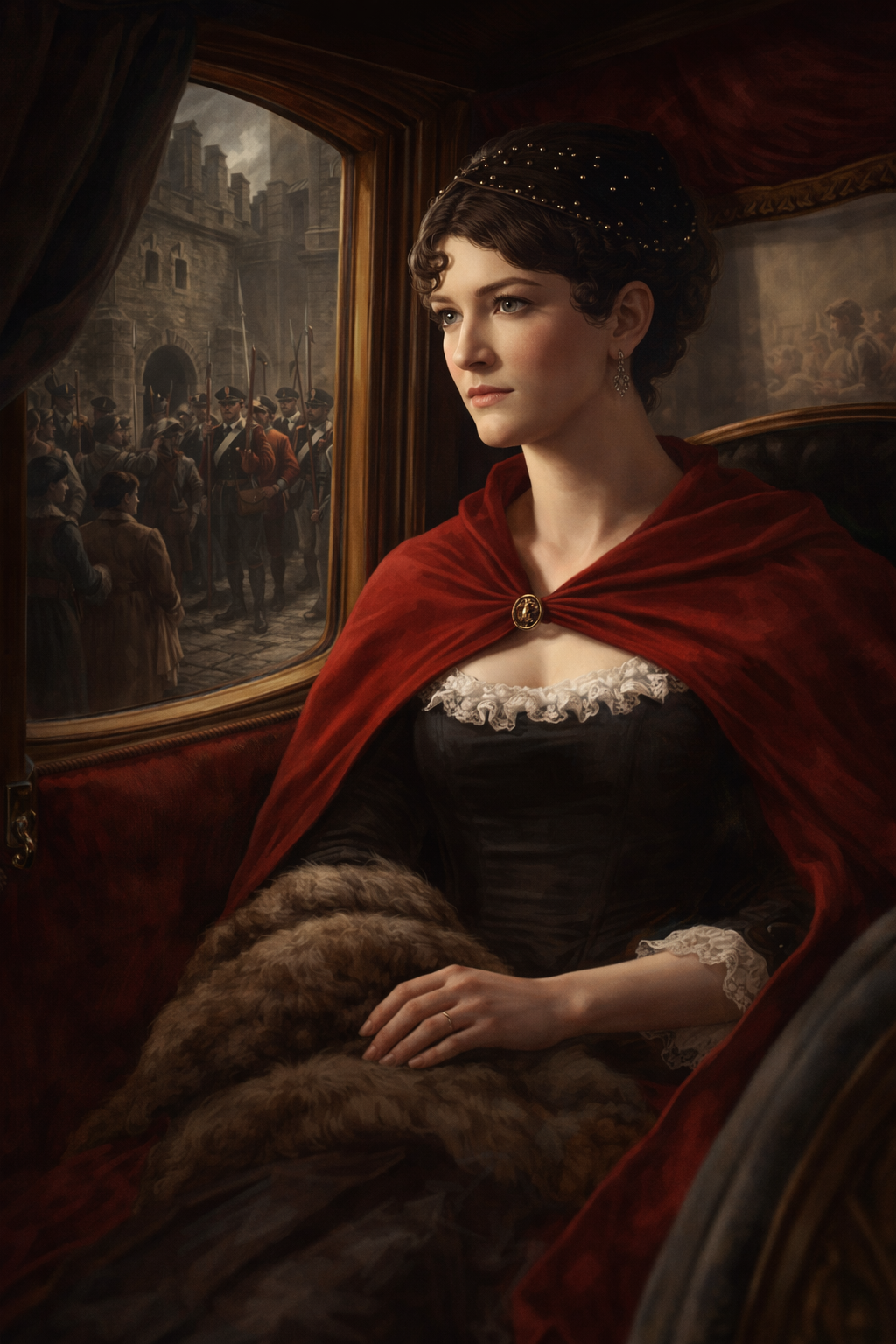
Elizabeth climbed into that carriage and rode through the streets of Paris to the Prison du Plessis.
The prison visit
Crowds gathered as the magnificent carriage approached the prison gates. Word spread quickly: this was the wife of the American Minister, and she was here to visit the condemned wife of Lafayette. Guards looked on uncertainly. What were they supposed to do? Turn away the representative of a friendly foreign nation?
Elizabeth demanded to see Madame Lafayette.
Adrienne was brought from her cell, probably expecting that she was being taken to her execution. Instead, she found herself face to face with a beautiful American woman who embraced her publicly, in full view of guards, officials, and gathered crowds.
Witnesses were in tears.
As Elizabeth left, she made it clear that she would return the next day to visit the prisoner again. This was not a one-time gesture. This was a statement: America was watching. America cared. And if Adrienne Lafayette met the guillotine, the American Minister's wife would arrive to find her friend executed.
What would be the American reaction then?
The outcome
The Committee of General Safety found themselves in an impossible position. They had planned to execute Madame Lafayette. But now, with the American Minister's wife making public visits, any such action would damage relations with one of France's few remaining friendly nations. The embarrassment would be enormous.
Days later, Robespierre fell. The Terror began to wind down. And in January 1795, Adrienne Lafayette was released from prison.
She would eventually travel to Austria, where she voluntarily joined her husband in his Austrian dungeon, sharing his imprisonment until Napoleon forced their release. She never forgot what Elizabeth Monroe had done for her.
The French called Elizabeth "La Belle Americaine," the beautiful American. But her beauty was not merely physical. It was strategic, political, courageous. A woman who, by contemporary accounts, was naturally reserved, who would later refuse to make social calls because she found them draining, had ridden through the streets of revolutionary Paris in a conspicuous carriage and demanded access to a condemned prisoner.
She had understood that sometimes the most powerful political act is not what officials do behind closed doors, but what private individuals do in full public view.
Part Three: The Partnership (1786-1825)
Point Two: The hidden counselor
Very little of Elizabeth and James Monroe's private correspondence survives. This is not an accident, as we shall see. But what we know from other sources reveals a partnership far deeper than the "devoted wife" narrative that history books usually offer.
In an 1811 letter, James Monroe explained to a correspondent that Elizabeth was assisting him in copying the lower portion of a letter. He noted that this demonstrated the "high level of confidentiality" he was maintaining regarding the contents. Think about what this means: the most sensitive diplomatic correspondence, material too confidential to trust to a secretary, was being handled by Elizabeth.
She was not merely copying. She was reading, understanding, and participating in the diplomatic work of the nation.
A letter from George Hay, Elizabeth's son-in-law and a prominent Virginia attorney, suggests that she was actively consulted for her political judgment in at least one difficult situation involving the controversial congressman John Randolph. This was not casual family discussion. This was a political leader seeking out Elizabeth Monroe's advice on handling a delicate political problem.
In 2014, scholars at the Papers of James Monroe were made aware of a letter from 1793, written by Elizabeth to James, held in a private collection. The letter revealed what the Monroe scholars described as her "intelligence, independence, and forthrightness." It demanded a revision of the standard historical narrative of Elizabeth as a "fragile and retiring First Lady."
James Monroe's own records, the historians note, "clearly indicate that he regularly sought out and acted on her observations and opinions." The formal, European-style protocol they established at the White House was "a carefully considered joint undertaking."
For nearly forty years, through his terms as diplomat, governor, Secretary of State, Secretary of War, and President, Elizabeth Monroe was constantly at his side. In an era when political wives routinely stayed home while their husbands served abroad or in distant capitals, Elizabeth followed James everywhere. She was present for every major decision, every diplomatic crisis, every political triumph and setback.
One contemporary recorded Monroe saying that Elizabeth had "shared fully" in all aspects of his public career and had always been motivated by "the interests of the United States." For a man of Monroe's generation and temperament to give his wife such credit speaks volumes about the reality of their partnership.
Part Four: The Education of a Daughter (1794-1808)
Point Three: A radical educational choice
When the Monroes arrived in Paris in 1794, their daughter Eliza was eight years old. Elizabeth faced a choice that would shape her daughter's entire life: where to educate her.
The obvious choice would have been to keep Eliza close, to educate her at home as most American girls of her class were educated, or to wait until they returned to America and find a suitable school there. Paris in 1794 was, after all, a city where aristocrats were being murdered in the streets.
Instead, Elizabeth enrolled Eliza in the school of Madame Jeanne-Louise Henriette Campan.
Madame Campan: A survivor
Madame Campan was one of the most remarkable women of her age. She had served as First Lady of the Bedchamber to Marie Antoinette, the queen's closest female attendant, present for the most intimate moments of royal life. She had been at the Tuileries Palace on August 10, 1792, when the revolutionary mob stormed it; she was left behind when the royal family fled, and her own house was pillaged and burned that same day.
Somehow, Madame Campan survived the Terror. And in 1794, finding herself nearly destitute, she opened a school at Saint-Germain-en-Laye.
This was not an ordinary finishing school for young ladies. Madame Campan was decades ahead of her time in her educational philosophy. She urged that women learn to speak modern languages, not merely read them. Her curriculum included science, history, geography, and mathematics, subjects that most educators considered unsuitable for female minds. She taught that punishment of children should be neither excessive nor frequent.
Napoleon himself would later notice the quality of Campan's students and appoint her director of the school founded in 1806 at Ecouen for female relatives of members of the Legion of Honour.
Classmates who would become queens
At Madame Campan's school, young Eliza Monroe found herself among extraordinary company. Her closest friend was Hortense de Beauharnais, whose mother, Josephine, had recently married a rising general named Napoleon Bonaparte. Also in attendance was Caroline Bonaparte, Napoleon's sister.
Think about what Elizabeth Monroe had done. She had placed her eight-year-old daughter in a school run by Marie Antoinette's former lady-in-waiting, surrounded by the stepdaughter and sister of the man who would soon rule France. As Eliza grew up in America, her father becoming Secretary of State, Secretary of War, and eventually President, her childhood friend Hortense was becoming Queen of Holland. Caroline would become Queen of Naples.
The friendship between Eliza and Hortense lasted their entire lives. They exchanged letters across the Atlantic for decades. When Eliza had a daughter, she named her Hortensia, and Hortense, by then Queen of the Netherlands, served as godmother. Hortense sent gifts to her namesake, including oil portraits of herself, her brother Eugene, and their beloved Madame Campan.
Elizabeth had given her daughter something more valuable than money or social position. She had given her a network, an education, and a sense of possibility that few American women of her generation could imagine.
Part Five: Redefining the First Lady (1817-1825)
Point Four: Setting her own boundaries
When James Monroe became President in 1817, Elizabeth faced an impossible standard. Her predecessor, Dolley Madison, had transformed the role of First Lady into something approaching a public office. Dolley had been everywhere, knew everyone, hosted elaborate open houses where any citizen could shake hands with the President's wife. She was beloved, democratic, accessible.
Elizabeth Monroe looked at this model and rejected it entirely.
She would neither make nor return the formal "calls" that Washington society expected, the visits that signified status and recognition. She would not host open houses where hundreds of strangers could wander through the White House. She would appear at carefully selected events, always surrounded by female relatives who could protect her from unwanted intrusion.
Washington society was outraged.
The boycott
The wives of diplomats, congressmen, and cabinet members organized a boycott of all Administration receptions. If Mrs. Monroe would not call on them, they would not attend her events. When Louisa Adams, wife of the Secretary of State, adopted the same policy at Elizabeth's request, her receptions were boycotted too.
President Monroe was forced to hold two Cabinet meetings to discuss the social crisis. On December 29, 1817, he explained the confusing rules of the new White House social policy. On December 20, 1819, after the boycott continued, he announced a compromise: while the President's family would maintain their rules, other Executive Branch officials were free to determine their own social policies.
But Elizabeth held firm. When the Monroes decided to skip the traditional Independence Day open house in 1819, staying instead at their Virginia home, even ordinary citizens were insulted.
The hidden reason
What Washington society did not know, and what the Monroes never publicly disclosed, was that Elizabeth suffered from epilepsy.
In an era when epilepsy was called "the falling sickness" and widely assumed to be a form of mental illness or demonic possession, Elizabeth Monroe lived with the constant possibility of a seizure. Public appearances were not merely exhausting for her; they were dangerous. A seizure at a formal reception would have destroyed her husband's presidency and subjected her to public humiliation and speculation about her sanity.
Rather than disclose her condition and face the stigma, Elizabeth simply changed the rules. She created boundaries that protected her health while maintaining her dignity. If society thought her cold, arrogant, or anti-democratic, that was a price she was willing to pay.
Victory
By Monroe's second term, Elizabeth had won. The boycott ended. Guests returned to the White House. Her European-style protocol, which had initially seemed so offensive to democratic sensibilities, came to be accepted as appropriate for the dignity of the Executive branch.
More importantly, Elizabeth had established a principle that would echo through American history: the First Lady was not obligated to sacrifice her health, privacy, or personal boundaries for public consumption. She could define her own role.
One notable exception to her withdrawal was the 1824 White House dinner honoring the Marquis de Lafayette, who was making a triumphant farewell tour of the United States. The man whose wife Elizabeth had saved from the guillotine thirty years earlier was finally able to thank his rescuer in person.
Part Six: The Burning (1830)
Point Five: The deliberate erasure
After leaving the White House in 1825, the Monroes retired to Oak Hill, their Virginia plantation. Elizabeth's health continued to decline. In 1826, just a year after leaving Washington, she suffered a severe seizure, collapsed near an open fireplace, and sustained terrible burns. She would live only three more years.
On her deathbed, Elizabeth Monroe gave instructions: her letters were to be burned.
This was not unusual for the era. Privacy was sacred, and destroying personal correspondence was considered a mark of respect and good breeding. Abigail Adams, who chose to preserve her letters, was the exception, not the rule.
But Elizabeth's burning was comprehensive in a way that suggests deliberate intent. According to their daughter Eliza, James Monroe burned his wife's correspondence after her death in 1830. Family tradition holds that Elizabeth herself burned correspondence prior to her passing. Between them, they destroyed virtually every record of their private life together.
Today, fewer than six letters written by Elizabeth Monroe survive. The only known letter from James to Elizabeth dates from 1787, the first year of their marriage. Forty-three years of partnership, of shared counsel, of intimate political discussion, all reduced to ashes.
Why?
Consider what those letters might have contained. Decades of correspondence between a wife and husband who worked together on the most sensitive matters of state. Elizabeth's opinions on political figures, diplomatic strategies, personal conflicts. Her advice to James during the negotiations that led to the Louisiana Purchase, the Monroe Doctrine, the Missouri Compromise.
Consider also the danger such letters might have posed. The Monroes had two daughters and grandchildren. James Monroe died deeply in debt, having spent his personal fortune in public service without adequate reimbursement. The family's financial situation was precarious.
If Elizabeth's letters revealed the extent of her political influence, if they showed her counseling her husband on matters of state, what might political enemies make of that? In an era when women were supposed to remain in the domestic sphere, evidence that a President's wife had been actively shaping policy could be used against the Monroe family, against their memory, against their descendants.
By burning her letters, Elizabeth ensured that her counsel would remain private. She protected her family. She also, perhaps intentionally, ensured that she would be remembered as the "fragile and retiring" First Lady of historical stereotype rather than the strategic political partner she had actually been.
It was her final act of control, her last assertion of the privacy she had always valued. And it worked perfectly. For two hundred years, historians had no choice but to describe Elizabeth Monroe as an enigma, a beautiful woman about whom almost nothing was known.
Epilogue: The Hidden Architect
Elizabeth Kortright Monroe died on September 23, 1830, at the age of sixty-two. Her husband, shattered by her loss, predicted he would not live long. He died ten months later, on July 4, 1831, the third president to pass on Independence Day.
Their daughter Eliza, who had befriended future queens and served as unofficial First Lady during her mother's illnesses, outlived them both. After the deaths of her husband and parents within two years, she returned to Paris, converted to Catholicism, and entered a convent. She died in 1840 and was buried in Pere Lachaise Cemetery. In October 2025, nearly two centuries later, her remains were finally repatriated to Virginia to be reinterred with her family.
What do we learn from Elizabeth Monroe's story?
We learn that power does not always announce itself. A woman who never held office saved a life through a single carriage ride. A wife who officially had no role in government shaped policy through four decades of private counsel. A mother who seemed merely to be enrolling her daughter in school was building networks that would span continents and generations. A First Lady who appeared to be retreating from public life was actually establishing the principle that women could set their own boundaries.
And a dying woman who burned her letters was not erasing her legacy. She was controlling it, ensuring that her private influence would remain private, that her family would be protected, that history would remember her as she wished to be remembered.
Elizabeth Monroe understood something that many powerful people never grasp: sometimes the most enduring influence is the influence no one sees. The hidden hand shapes history as surely as the visible one. The woman standing beside the great man may be the one telling him what to do.
She was "La Belle Americaine," the beautiful American. But her real beauty was her mind: strategic, courageous, and utterly private.
That is the power of hidden women in history. They change everything, and then they disappear into the flames.
Timeline of Elizabeth Monroe's Life
1768, June 30 — Born in New York City to Lawrence Kortright and Hannah Aspinwall
1777 — Mother Hannah dies; Elizabeth is nine years old
1786, February 16 — Marries James Monroe at Trinity Episcopal Church, New York, at age 17
1786, December — Daughter Eliza Kortright Monroe born in Virginia
1794, August — Arrives in Paris with James (now US Minister to France) and daughter Eliza
1794, September — Father Lawrence Kortright dies in New York
1794-1795 — Visits Adrienne Lafayette in prison; helps secure her release from the guillotine
1794-1796 — Enrolls Eliza in Madame Campan's prestigious school in Paris
1796 — Monroe recalled from France; family returns to Virginia
1799, May — Son James Spence Monroe born
1799-1802 — James Monroe serves as Governor of Virginia; Elizabeth is First Lady of Virginia
1800, September — Son James Spence dies at 16 months old
1802, April — Daughter Maria Hester Monroe born
1803-1807 — Lives in Paris and London while James serves as Minister to France and Britain
1808 — Daughter Eliza marries George Hay, prominent Virginia attorney
1811-1817 — James serves as Secretary of State and Secretary of War under President Madison
1817, March 4 — James Monroe inaugurated as 5th President; Elizabeth becomes First Lady
1817-1819 — Establishes European-style protocol at White House; faces social boycott
1820, March — Daughter Maria marries Samuel Gouverneur at White House (first presidential daughter to wed there)
1824 — Hosts dinner for Marquis de Lafayette at White House, reuniting with the man whose wife she saved
1825, March 4 — Monroe presidency ends; retires to Oak Hill plantation in Virginia
1826 — Suffers severe seizure, collapses near fireplace, sustains major burns
1830, September 21 — Son-in-law George Hay dies
1830, September 23 — Elizabeth Monroe dies at Oak Hill at age 62; letters burned per her wishes
1831, July 4 — James Monroe dies in New York City
1903 — Elizabeth's remains moved from Oak Hill to Hollywood Cemetery, Richmond, Virginia
Let me know in the comments if you enjoyed that my little research and novella into the Elizabeth Monroe's life and bio.